Career Development System: Skills, Resume, Networking
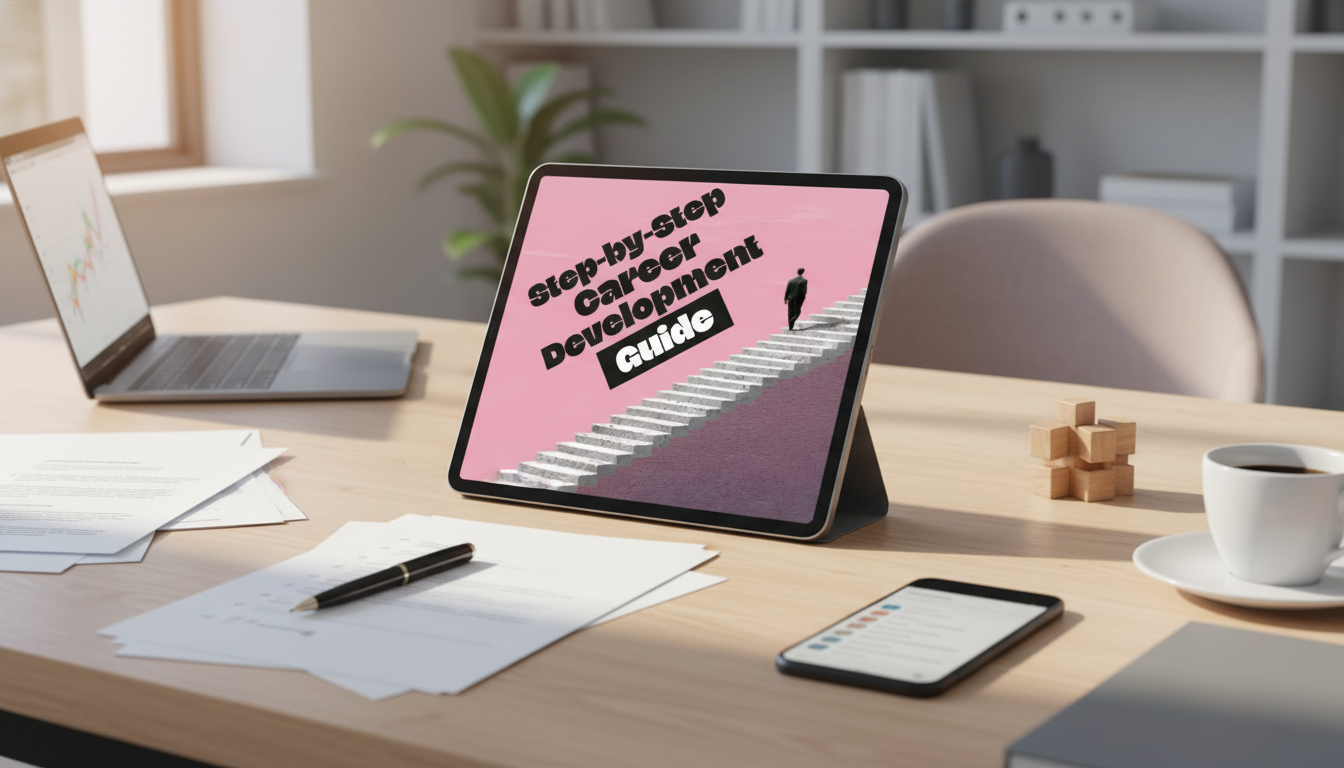
Step-by-Step Career Development Guide for Professional Growth, Job Search, Networking & Resume Writing
Career progress becomes easier to manage when goals, skills, and opportunities are handled in a repeatable system. The most sustainable approach is to clarify direction first, then build proof, tighten your materials, and run networking and applications with a cadence you can keep—even on busy weeks. Below is a practical sequence for building momentum and reducing guesswork, supported by a structured playbook you can reuse for future role changes.
Start with clarity: roles, values, and a 90-day direction
Clarity is the step that makes everything else faster. Instead of chasing every “interesting” posting, define a role family and work context you can commit to for the next 90 days.
- Define a target role family (2–3 options) and your preferred environment: team style, pace, industry, and remote/hybrid/on-site.
- List strengths you want to use daily and constraints to avoid (schedule, travel, leadership expectations, stressors).
- Write a simple career headline: “Role + domain + impact” (example: “Operations Analyst improving forecasting and process quality”).
- Set a 90-day plan with three outcomes: one skill upgrade, one portfolio/proof item, and one networking routine.
- Identify the top 10 job titles to track and the core requirements that repeat across postings.
If you’re unsure which roles have stable demand, cross-check titles and growth outlook using the U.S. Bureau of Labor Statistics Occupational Outlook Handbook. This helps you prioritize paths with clearer hiring patterns.
Build your skill stack and proof of impact
Hiring decisions are easier when a recruiter or manager can quickly connect your skills to evidence. A clean method is to map job requirements to your current ability, then turn the biggest gaps into visible proof.
- Audit requirements from job postings and map them to current ability: strong, moderate, gap.
- Choose one “core skill” (role-specific), one “adjacent skill” (cross-functional), and one “signal skill” (tool or certification recruiters recognize).
- Create proof: a case study, before/after metrics, a project summary, or a short presentation showing decisions and results.
- Use a weekly cadence: 2 focused learning blocks + 1 deliverable that can be shown to others.
- Collect stories using a STAR outline (Situation, Task, Action, Result) with measurable outcomes where possible.
Skill-to-Proof Planner
| Skill area | Proof you can show | Timeframe | Where it goes |
|---|---|---|---|
| Role-specific skill | Mini project or case study with metrics | 2–4 weeks | Resume bullets + LinkedIn featured |
| Tool/tech skill | Screenshot walkthrough or short demo | 1–2 weeks | Portfolio link |
| Leadership/communication | Meeting facilitation notes + outcome summary | Ongoing | Interview stories |
When choosing what to learn next, aim for skills that show up repeatedly in postings and directly support outcomes. For broader guidance on career planning, Harvard Business Review’s career planning topics can help you pressure-test what matters at different levels (individual contributor vs. manager vs. cross-functional lead).
Resume structure that gets to the point
A strong resume reads like a highlight reel for one target role family. It reduces scanning time and increases the chance your most relevant impact is noticed first.
- Lead with a targeted summary (2–3 lines) that mirrors the role’s priorities without copying job text.
- Write experience bullets as outcomes: action + method + impact (numbers where possible; scope if numbers aren’t available).
- Prioritize relevance: reorder bullets so the most job-aligned achievements appear first under each role.
- Keep formatting simple for readability: consistent dates, titles, locations, and bullet punctuation.
- Add a focused skills section: only tools and capabilities that support target roles (avoid long “everything” lists).
- Prepare a second version if switching targets (for example, operations vs. program management) rather than forcing one resume to fit all.
Practical tip: keep an “achievement log” separate from your resume. That document can be messy, long, and chronological—then you pull only the best, most relevant bullets into each tailored version.
Networking that feels natural and produces opportunities
If you need a low-friction place to find roles and identify hiring teams, use LinkedIn’s job search resources to spot patterns across postings and discover who’s posting or sharing team updates.
Run a focused job search like a pipeline
Weekly Job Search Pipeline
| Stage | Target per week | How to measure | Notes |
|---|---|---|---|
| Targeted applications | 5–10 | Submitted + role fit score | Prioritize roles matching top skills |
| Networking touches | 3–5 | Messages sent + replies | Keep asks small and specific |
| Conversations | 1–2 | Calls completed | Document insights and next steps |
| Interview practice | 1 session | Questions drilled | Record and tighten answers |
Use a step-by-step ebook as a working system
For a ready-to-use digital playbook format, consider the Step-by-Step Career Development Guide – Professional Growth, Job Search, Networking & Resume Writing Ebook.
To keep your search materials portable—especially for networking events, job fairs, or commuting—some people also prefer a dedicated bag for notebooks, printouts, and a laptop. The Large-Capacity Multi-Function Diaper Backpack for Everyday Parenting can double as an everyday carry option with room for essentials.
FAQ
How long does it take to see results from a structured career development plan?
Many people see clearer positioning and a stronger resume in 2–4 weeks, stronger network momentum in 4–8 weeks, and interview traction in 8–12+ weeks. Timelines vary based on role level, market conditions, and how consistent your weekly pipeline is.
What should be customized for every job application?
Customize the summary, top skills, and the first 2–4 bullets under your most relevant roles so they match the role’s must-haves. Keep the core achievement content consistent, and add a brief cover note only when it’s required or truly useful.
How do you network if you have a small professional circle?
Start with alumni groups, local community events, online professional groups, volunteering, and informational interviews to create new warm paths. Use a short outreach message with a specific ask (10–15 minutes) and follow up in 4–6 weeks with a helpful update.











Leave a comment